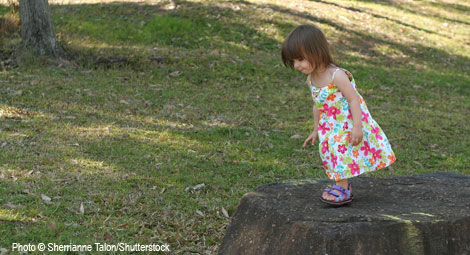
The Unsafe ChildLess Outdoor Play is Causing More Harm than Good
By Angela HanscomThe third grade classroom that was visiting our Nature Center for the day consisted of mostly boys – rowdy, loud, and rambunctious boys. As we started out into the woods, the children spoke loudly to each other in anticipation of what was to come. After playing a quick game and explaining the ground rules, it was time for free play. As soon as the children realized they had the freedom to explore and build in the woods, something funny happened – they got really quiet. They dispersed and many of them started working together to build a large teepee. Nothing gives me more pleasure than to see children contentedly building a structure using branches and logs out in the woodland. That is, until fear kicks in and everyone’s pulse increases a few notches at the shrill cry of alarm. “Put the sticks DOWN!” I looked over to see a chaperone running frantically towards the children. “Danger! Danger!” she screamed. Momentarily astonished by the sudden state of perceived emergency, I finally found my voice. “It’s okay,” Iyelled over to her. “I said they could use the sticks as long as they respect each other’s personal space.” Speechless, the chaperone frowned, turned, and walked to a group of nearby chaperones. I could have stopped the kids from building at this point, given into the fear, and encouraged them to do something that our society would consider a little less risky. However, I decided to let the kids proceed with their project. The children, with the help of a few excited adults, proceeded to build a massive stick teepee. “Look at what we built!” one of the boys said proudly, showing off their work. “Can you believe it?” another child asked excitedly. During this time of construction, ironically, no child got hurt – not even a scratch. This is rare. Children usually get some bumps and bruises while playing in the woods. Getting scrapes, bruises, and even scars was like a rite of passage when I was growing up. No cuts, no scrapes, nothing on this day. As a parent of two girls, on some level I can empathize with that chaperone’s fear. Parental instincts often naturally take over and we shout, “Be careful” or “Slow down” as we watch a child manipulate her natural environment. This is fairly normal and common. However, as a pediatric occupational therapist who spends countless hours observing children playing in a natural environment, I also know that restricting children’s movement and limiting their ability to play outdoors can cause more harm than good. As we continue to decrease children’s time and space to move and play outdoors, we are seeing a simultaneous rise in the number of children who are presenting with sensory deficits. The number of children who now need occupational therapy services to treat their sensory systems is on the rise. According to the New York Times, New York City public schools have seen a thirty percent increase in the number of students being referred to occupational therapy in the past four years. And they aren’t the only city seeing the surge of children in need of services. Chicago is up twenty percent in the past three years and Los Angeles jumped to a thirty percent increase in the past five years. Secondary to restricted movement and less time outdoors on a regular basis, more and more children are walking around with underdeveloped vestibular (balance) systems. In other words, they have decreased body awareness and sense of space. Teachers are reporting that children are falling out of their seats in school, running into one another, pushing with more force during games of tag, and are generally clumsier than in years past. In fact, the more we restrict and coddle our children, the more unsafe they become. A child’s neurological system is naturally designed to seek out the sensory input it needs in order to develop into a strong and capable individual. For instance, if a child starts jumping off small rocks, that is because her brain is ready for this type of activity. If a child is spinning in circles just for fun, it is because he needs that sensory input. If she climbs a tree effortlessly, it means she is capable of doing so. It is only when adults consistently step in and say, “No” to everything physical the child attempts that we start to see problems in development. “No climbing,” “No running,” “No playing tag,” “No spinning,” “No picking up sticks,” “No getting dirty,” “No jumping off the rocks,” “No climbing the rocks,” we yell when children attempt any kind of risky behavior. We care about our children so much. We are just trying to protect them. However, sometimes too much protection can cause more harm than good. We are keeping them from attaining the very sensory input they need in order to grow into resilient and able-bodied people. They need to climb, jump, run through the woods, pick up sticks, jump in mud puddles, and fall and get hurt on occasion. These are all natural and necessary experiences that will help develop a healthy sensory system – foundational to learning and accomplishing many of life’s goals. Examples of How Play Outdoors Can be Therapeutic: 1. Sledding: 2. Walking barefoot in the woods: 3. Rolling down a grassy hill: Playing outdoors is naturally a wonderful sensory experience for children. However, just once-a-week excursions are not enough in order to develop a healthy sensory system. Just like exercising on occasion doesn’t gain lasting benefits, children need to move and play on a frequent and regular basis in order to reap the sensory advantages of the outdoors. They also need to be surrounded by adults who support not only regular outdoor play, but also encourage healthy risk-taking. Their sensory system depends on it. Angela Hanscom is a pediatric occupational therapist and the founder of TimberNook, which focuses on Nature-centered developmental programming in New England. Angela holds a master’s degree in occupational therapy and an undergraduate degree in Kinesiology (the study of movement) with a concentration in health fitness. She specializes in vestibular (balance) treatment and sensory integration. She is also the author of the nonfiction book, “Balanced and Barefoot: How Unrestricted Outdoor Play Makes for Strong, Confident, and Capable Children,” which discusses the effects of restricted movement and lack of outdoor playtime on overall sensory development in children. This article is reprinted with the permission of the Children & Nature Network and is © May 2015 Angela Hanscom. |
|
|